
August 14, 2026
A fiscal accident waiting to happen
But France is not the only country losing control of its public finances.


To the point!

"Capital markets now have to deliver the wake‑up call."
When I began analyzing European sovereign credit at a major rating agency in early 2001, Germany and France were almost indistinguishable in terms of debt, deficits and broader macroeconomic indicators. They were, to borrow from the “Tintin” comics, like the near‑identical detectives Thomson and Thompson – distinguishable only to committed connoisseurs. The finance and foreign ministers of what were then the twelve member states of the European Community did not pick a public‑debt ceiling of 60% of GDP in the Maastricht Treaty at random. That level essentially mirrored the debt ratios of the bloc’s two economic heavyweights, Germany and France. That was a long time ago. Fast forward to today, and the contrast could hardly be starker – even though Germany itself has now embarked on a debt‑funded spending spree. France’s general‑government gross debt stands at 118% of GDP, compared with 65% in Germany (see fig. 1). Since 2020, France’s budget deficit has averaged just under 6% of GDP – roughly twice Germany’s (see fig. 2). Over the same period, French public spending has risen to 57% of GDP. In Germany, that ratio is expected to exceed 50% for the first time this year – a threshold beyond which, as former German chancellor Helmut Kohl once quipped, socialism begins.
Fig. 1: Public debt (% of GDP)
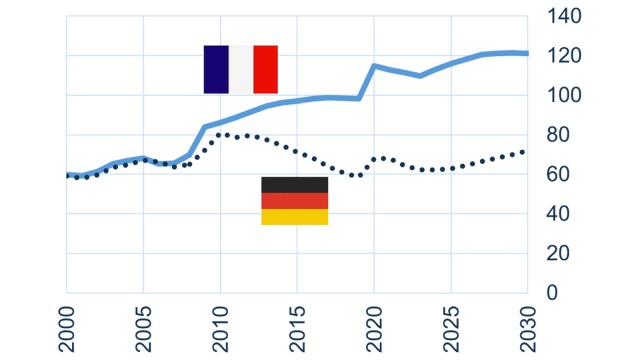
Source: IWF, LBBW Research
Fig. 2: Public debt (% of GDP)
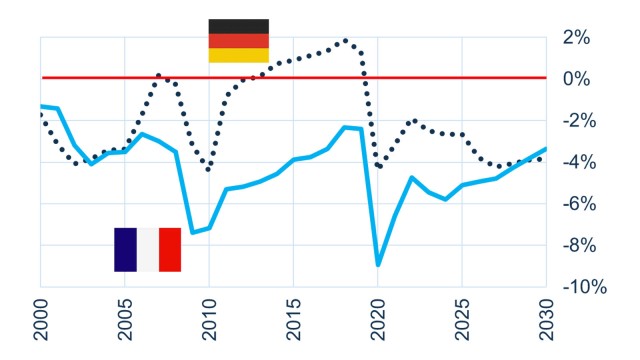
Source: IWF, LBBW Research
Quel dommage!
Why have the numbers drifted so far apart when the two countries were near‑macroeconomic twins some 25 years ago? The explanation is not weaker growth in France. Since the turn of the millennium, the French economy has in fact grown slightly faster than Germany’s. My own view is that the divergence largely reflects different approaches to fiscal rules – with Germany, untilrecently, sticking to its self‑imposed “debt brake,” a constitutional cap on structural deficits. Fiscal rules tend to work best in societies that least need them, because of a preexisting broad consensus on the virtues of cautious fiscal policy. France last recorded a budget surplus in 1974. In German, on the other hand, the word for “debt” is the same as for “guilt”. Many societies today are sharply polarized – Germany increasingly among them. The deeper the divisions, the weaker the attachment to fiscal discipline is likely to be. Governments try to win over voters with generous promises, even though this tactic has yet to deliver lasting results anywhere. Against that backdrop, the highly contentious presidential election that France faces in 2027 is another source of anxiety.The slow unravelling of Europe’s stability pact
In theory, the European Union’s Stability and Growth Pact (SGP) – designed to keep member states’ deficits and debts within bounds – could have played a role similar to Germany’s debt brake. In practice, Brussels has struggled to enforce it through credible sanctions. Some may still recall the comment made in 2016 by then-European Commission president Jean‑Claude Juncker, when he explained why Paris was being granted more fiscal leeway: “Because it is France!” Successive exemptions and special arrangements have further undermined the SGP’s credibility. And, unsurprisingly, the adjustments have been one‑sided: in difficult times the EU has effectively relaxed the limits; in more benign periods – for instance during the long era of ultra‑low interest rates – there was no offsetting tightening of the targets.
Capital markets now have to deliver the wake‑up call
In principle, it falls upon rating agencies to sound the warning. Yet they increasingly appear reluctant to confront the very sovereigns that regulate them. The wave of lawsuits and regulatory counter‑attacks in the euro area after the sovereign‑debt crisis was not lost on the agencies. The fact that two of the three major firms (S&P and Fitch) now assign France only an A+ rating is less daring than it might seem. Historically, according to data from S&P Global, the five‑year default probability for a sovereign in the A category has been only about 1% – essentially negligible. Germany’s AAA – the credit‑rating equivalent of a top grade with an extra star – remains unquestioned by all agencies. That leaves capital markets to enforce discipline through higher borrowing costs – precisely the outcome the SGP was meant to prevent. With every year that the debt binge continues – not justin France, but across most large advanced economies – the risk grows that governments will exert such pressure on central banks through their fiscal stance that monetary policymakers can no longer focus on price stability without pushing sovereigns into trouble. That is a bleak prospect – for price stability and financial stability alike. Better to make a fiscal U-turn now!
Dr. Moritz Kraemer, Chief Economist / Head of Research at LBBW
Download To the point!
-
1.3 MB | August 14, 2026
This publication is addressed exclusively at recipients in the EU, Switzerland, Liechtenstein and the United Kingdom.
This report is not being distributed by LBBW to any person in the United States and LBBW does not intend to solicit any person in the United States.
LBBW is under the supervision of the European Central Bank (ECB), Sonnemannstraße 22, 60314 Frankfurt/Main (Germany) and the German Federal Financial Supervisory Authority (BaFin), Graurhein-dorfer Str. 108, 53117 Bonn (Germany) / Marie-Curie-Str. 24-28, 60439 Frankfurt/Main (Germany).
This publication is based on generally available sources which we are not able to verify but which we believe to be reliable. Nevertheless, we assume no liability for the accuracy and completeness of this publication. It conveys our non-binding opinion of the market and the products at the time of the editorial deadline, irrespective of any own holdings in these products. This publication does not replace individual advice. It serves only for informational purposes and should not be seen as an offer or request for a purchase or sale. For additional, more timely in-formation on concrete investment options and for indi-vidual investment advice, please contact your investment advisor.
We retain the right to change the opinions expressed herein at any time and without prior notice. More-over, we retain the right not to update this information or to stop such updates entirely without prior notice.
Past performance, simulations and forecasts shown or described in this publication do not constitute a reliable indicator of future performance.
The acceptance of provided research services by a securities services company can qualify as a benefit in supervisory law terms. In these cases LBBW assumes that the benefit is intended to improve the quality of the relevant service for the customer of the benefit recipient.
Additional Disclaimer for recipients in the United Kingdom:
Authorised and regulated by the European Central Bank (ECB), Sonnemannstraße 22, 60314 Frank-furt/Main (Germany) and the German Federal Financial Supervisory Authority (BaFin), Graurheindorfer Str. 108, 53117 Bonn (Germany) / Marie-Curie-Str. 24-28, 60439 Frankfurt/Main (Germany). Authorised by the Prudential Regulation Authority. Subject to regulation by the Financial Conduct Authority and limited regulation by the Prudential Regulation Authority. Details about the extent of our regulation by the Prudential Regulation Authority are available from us on request.
This publication is distributed by LBBW to professional clients and eligible counterparties only and not retail clients. For these purposes, a retail client means a person who is one (or more) of (i) a client as defined in point (7) of Article 2(1) of the UK version of Regulation (EU) 600/2014 which is part of UK law (UK MiFIR) by virtue of the European Union (Withdrawal) Act 2018 (EUWA) who is not a professional client (as defined in point (8) of Article 2(1) of UK MiFIR); or (ii) a customer within the meaning of the provisions of the Financial Services and Markets Act 2000 (as amended, the FSMA) and any rules or regulations made under the FSMA (which were relied on immediately before the 31 December 2020 (IP completion day)) to implement Directive (EU) 2016/97 on insurance distribution, where that customer would not qualify as a professional client, as defined in point (8) of Article 2(1) of UK MiFIR; or (iii) not a qualified investor as defined in the UK version of Regulation (EU) 2017/1129 on the prospectus to be published when securities are offered to the public or admitted to trading on a regulated market, which is part of UK law by virtue of the EUWA (the UK Prospectus Regulation).
This publication has been prepared by LBBW for information purposes only. It reflects LBBW’s views and it does not offer an objective or independent outlook on the matters discussed. The publication and the views expressed herein do not constitute a personal recommendation or investment advice and should not be relied on to make an investment decision. The appropriateness of a particular investment or strategy will depend on an investor’s individual. You should make your own independent evaluation of the relevance and adequacy of the information contained in this publication and make such other investigations as you deem necessary, including obtaining independent financial advice, before partici-pating in any transaction in respect of the financial instruments referred to this publication herein.
Under no circumstance is the information contained within such publication to be used or considered as an offer to sell or a solicitation of an offer to buy any particular investment or security. Neither LBBW nor any of its subsidiary undertakings or affiliates, directors, officers, employees, advisers or agents accepts any responsibility or liability whatsoever for/or makes any representation or warranty, express or implied, as to the truth, fullness, accuracy or completeness of the information in this publication (or whether any information has been omitted from the publication) or any other information relating to the, whether written, oral or in a visual or electronic form, and howsoever transmitted or made available or for any loss howsoever arising from any use of this publication or its contents or otherwise arising in connection therewith.
The information, statements and opinions contained in this publication do not constitute or form part of a public offer. LBBW assumes no responsibility for any fact, recommendation, opinion or advice con-tained in any such publication and expressly disclaims any responsibility for any decisions or for the suitability of any security or transaction based on it. Any decisions that a professional client or eligible counterparty may make to buy, sell or hold a security based on such publication will be entirely their own and not in any way deemed to be endorsed or influenced by or attributed to LBBW.
LBBW does not provide investment, tax or legal advice. Prior to entering into any proposed transaction on the basis of the information contained in this publication, recipients should determine, in consultation with their own investment, legal, tax, regulatory and accounting advisors, the economic risks and merits, as well as the legal, tax, regulatory and accounting characteristics and consequences, of the transac-tion.