
August 07, 2026
Heat waves are eroding our prosperity
The economic costs of climate change become ever more visible.


To the point!

"Climate change is not just a buzzword; it is causing real damage. And we are seeing the consequences more clearly than ever before."
Not the heat again, some readers may groan. True: I devoted this column to climate change as recently as mid-June . The core of the analysis then was to document the overwhelming scientific evidence for human-induced climate change – and to explain why Europe is particularly exposed to global warming.
Currently, we are seeing the consequences more clearly than ever before. With Europe now enduring its second heat wave of the summer, forests are burning across Southern Europe. Grain and vegetables are withering in the fields – or failing to grow in the first place. Farmers are forecasting crop failures “on an unprecedented scale”. Predictably, demands for government support have followed quickly. I have some sympathy, even if the farmers’ protests have sometimes gone a little too far for my taste. Many farms may not survive, especially as droughts become more frequent and more intense.
A mounting body count in the battle against the heat
According to estimates by the Robert Koch Institute, Germany’s public-health agency, the country had already recorded almost 12,000 heat-related deaths by late July. That is an all-time high (see fig. 1). More than 95% of this so-called excess mortality is seniors over 65 years of age. The number is likely to have risen further after another week of fierce heat.
Fig. 1: Estimated heat-related deaths in Germany through end of July
France, for example, drew up plans after the scorching summer of 2003 to soften the impact on the population. Germany still finds itself unprepared for successive heat waves.
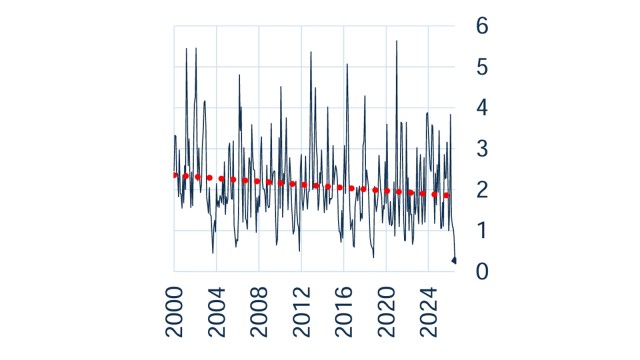
But if avoidable loss of life is not enough to jolt those in power into action, perhaps the economic damage will be. It is most obvious at present in the low water levels of Germany’s rivers – and not only the Rhine. The Danube, Elbe, Moselle and Spree look much the same. But the Rhine accounts for 80% of traffic on German waterways and is the main transport artery for oil products, chemicals, coal, scrap metal, grain and containers. Water levels at Kaub, a critical bottleneck on the Rhine, are at their lowest since records began in 1880 (see fig. 2). Ships can pass only with light loads. As a consequence, freight costs are rising exponentially. Industrial supply chains are stressed.
Fig. 2: Rhine water level at Kaub (in meters, through August 4, 2026)
It does not help that parts of the railway line along the Rhine’s eastern bank will remain out of service until at least December because of track repairs. The Rhine disruption alone could, according to estimates by the German Economic Institute, a Cologne-based think tank, shave as much as 0.4% off growth. That would once again dash hopes of a German economic recovery. A recession may even loom.
What, then, is Berlin saying? A spokesman for the transport ministry is laconic: “If there is no water, we are all at our wits’ end.” Of course, Berlin has no hotline to the rain gods. But such a casual shrug is not effective crisis management.
Energy and tourism are suffering, too
It is not only transport. France, Hungary and Romania are currently having to throttle back or shut down nuclear power plants because of a lack of cooling water. Coal-fired plants are affected, too, as they also need lots of water for cooling. EDF, France’s state-controlled utility, even had to take a gas-fired power plant on the Mediterranean coast offline because of the heat – the first such shutdown.
Tourism is suffering as well. River cruises have all but stopped. Lake Constance, which borders Germany, Switzerland and Austria, has reached its lowest level since measurements began. Even my mother, who has vacationed at Lake Constance for decades, no longer wants to visit her beloved lake.
Productivity falls as temperatures rise
Labor productivity collapses when temperatures rise above 30°C, or 86°F. And not only because sick leave increases. In one study, the insurer Allianz estimates that every degree above that threshold reduces productivity by 3%. Spare a thought for especially hard-hit outdoor workers.
I am convinced that the effects of heat – from agriculture and supply chains to energy supply – could yet trigger a burst of inflation, regardless of whether the war in the Middle East continues. And this is only the beginning. Some of the hottest weeks are still ahead of us. So what is Germany’s federal government doing? It advises people to drink enough water, points to the responsibility of federal states and municipalities, and shifts financial support away from renewables toward the construction of gas-fired power plants. Wakey, wakey!
Dr. Moritz Kraemer, Chief Economist / Head of Research at LBBW
Download To the point!
-
191.1 KB | August 07, 2026
This publication is addressed exclusively at recipients in the EU, Switzerland, Liechtenstein and the United Kingdom.
This report is not being distributed by LBBW to any person in the United States and LBBW does not intend to solicit any person in the United States.
LBBW is under the supervision of the European Central Bank (ECB), Sonnemannstraße 22, 60314 Frankfurt/Main (Germany) and the German Federal Financial Supervisory Authority (BaFin), Graurhein-dorfer Str. 108, 53117 Bonn (Germany) / Marie-Curie-Str. 24-28, 60439 Frankfurt/Main (Germany).
This publication is based on generally available sources which we are not able to verify but which we believe to be reliable. Nevertheless, we assume no liability for the accuracy and completeness of this publication. It conveys our non-binding opinion of the market and the products at the time of the editorial deadline, irrespective of any own holdings in these products. This publication does not replace individual advice. It serves only for informational purposes and should not be seen as an offer or request for a purchase or sale. For additional, more timely in-formation on concrete investment options and for indi-vidual investment advice, please contact your investment advisor.
We retain the right to change the opinions expressed herein at any time and without prior notice. More-over, we retain the right not to update this information or to stop such updates entirely without prior notice.
Past performance, simulations and forecasts shown or described in this publication do not constitute a reliable indicator of future performance.
The acceptance of provided research services by a securities services company can qualify as a benefit in supervisory law terms. In these cases LBBW assumes that the benefit is intended to improve the quality of the relevant service for the customer of the benefit recipient.
Additional Disclaimer for recipients in the United Kingdom:
Authorised and regulated by the European Central Bank (ECB), Sonnemannstraße 22, 60314 Frank-furt/Main (Germany) and the German Federal Financial Supervisory Authority (BaFin), Graurheindorfer Str. 108, 53117 Bonn (Germany) / Marie-Curie-Str. 24-28, 60439 Frankfurt/Main (Germany). Authorised by the Prudential Regulation Authority. Subject to regulation by the Financial Conduct Authority and limited regulation by the Prudential Regulation Authority. Details about the extent of our regulation by the Prudential Regulation Authority are available from us on request.
This publication is distributed by LBBW to professional clients and eligible counterparties only and not retail clients. For these purposes, a retail client means a person who is one (or more) of (i) a client as defined in point (7) of Article 2(1) of the UK version of Regulation (EU) 600/2014 which is part of UK law (UK MiFIR) by virtue of the European Union (Withdrawal) Act 2018 (EUWA) who is not a professional client (as defined in point (8) of Article 2(1) of UK MiFIR); or (ii) a customer within the meaning of the provisions of the Financial Services and Markets Act 2000 (as amended, the FSMA) and any rules or regulations made under the FSMA (which were relied on immediately before the 31 December 2020 (IP completion day)) to implement Directive (EU) 2016/97 on insurance distribution, where that customer would not qualify as a professional client, as defined in point (8) of Article 2(1) of UK MiFIR; or (iii) not a qualified investor as defined in the UK version of Regulation (EU) 2017/1129 on the prospectus to be published when securities are offered to the public or admitted to trading on a regulated market, which is part of UK law by virtue of the EUWA (the UK Prospectus Regulation).
This publication has been prepared by LBBW for information purposes only. It reflects LBBW’s views and it does not offer an objective or independent outlook on the matters discussed. The publication and the views expressed herein do not constitute a personal recommendation or investment advice and should not be relied on to make an investment decision. The appropriateness of a particular investment or strategy will depend on an investor’s individual. You should make your own independent evaluation of the relevance and adequacy of the information contained in this publication and make such other investigations as you deem necessary, including obtaining independent financial advice, before partici-pating in any transaction in respect of the financial instruments referred to this publication herein.
Under no circumstance is the information contained within such publication to be used or considered as an offer to sell or a solicitation of an offer to buy any particular investment or security. Neither LBBW nor any of its subsidiary undertakings or affiliates, directors, officers, employees, advisers or agents accepts any responsibility or liability whatsoever for/or makes any representation or warranty, express or implied, as to the truth, fullness, accuracy or completeness of the information in this publication (or whether any information has been omitted from the publication) or any other information relating to the, whether written, oral or in a visual or electronic form, and howsoever transmitted or made available or for any loss howsoever arising from any use of this publication or its contents or otherwise arising in connection therewith.
The information, statements and opinions contained in this publication do not constitute or form part of a public offer. LBBW assumes no responsibility for any fact, recommendation, opinion or advice con-tained in any such publication and expressly disclaims any responsibility for any decisions or for the suitability of any security or transaction based on it. Any decisions that a professional client or eligible counterparty may make to buy, sell or hold a security based on such publication will be entirely their own and not in any way deemed to be endorsed or influenced by or attributed to LBBW.
LBBW does not provide investment, tax or legal advice. Prior to entering into any proposed transaction on the basis of the information contained in this publication, recipients should determine, in consultation with their own investment, legal, tax, regulatory and accounting advisors, the economic risks and merits, as well as the legal, tax, regulatory and accounting characteristics and consequences, of the transac-tion.