May 26, 2026
Up the biogas ladder – into a policy trap?
There is no way around electrifying the German heating market.
Sabrina Kremer´s focus on facts

The risk is high that the biogas ladder will quickly turn into a biogas trap.
Over the past three years, Germany’s Building Energy Act (GEG) has repeatedly made headlines. In the election campaign, the conservative Christian Democratic Union (CDU) promised to abolish the law that tabloid media had dubbed the “heating hammer”. Now words are being backed by action: the government has presented a draft for the so-called Building Modernization Act (GMG).
In new buildings, this would mean that heating systems would no longer have to be designed from the outset to run on at least 65 % renewable energy. For existing buildings, this rule under the GEG would have applied from June. In both cases, the renewable share would have had to rise to 100 % by 2045. The new GMG instead provides, starting in 2029, for an initial renewable quota of only 10 %, which then increases much more gradually, in what it calls a “biogas ladder”. The obligation to heat exclusively with renewables from 2045 onwards disappears entirely. Both laws have suggested that gas heating systems running on biogas have a future – the new one even more so than the old.
With biogas, it gets more expensive
The market already offers tariffs with a biomethane share of 15 % or 65 %. The number of such products listed on price comparison portal Verivox has almost doubled over the past two years, rising from 189 to 326. A closer look reveals that blending in biomethane makes heating more expensive. A sample shows that, for a 10 % to 65 % biogas blend, the current price per kilowatt hour (kWh) is around 1 to 3 euro cents above that of conventional gas tariffs. For an Art Nouveau building, constructed in the early 20th century, partially renovated, annual consumption for heating and hot water on 100 square meters easily comes to 15,000 to 20,000 kWh. At today’s prices, that translates into 150 to 600 euros in additional annual costs for biogas.
Generating power beats “refining” gas
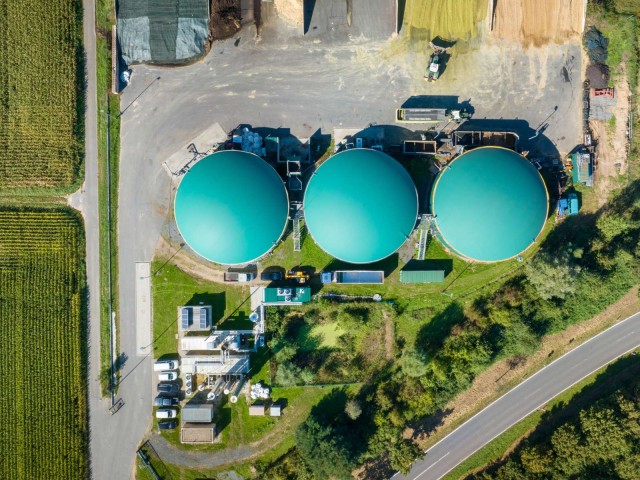
If you compare biogas tariffs with 12‑ and 24‑month terms, one thing stands out: tariffs with longer terms are more expensive than those with shorter ones. For conventional gas tariffs, the opposite is true – they reward loyalty with lower prices. For biogas, providers are obviously building a price increase into their calculations. The reason is simple: there is not much biomethane, and the problem will become more acute. A survey counted a total of 9,605 biomass plants in Germany at the end of 2025. Of these, only 290 upgraded biogas to biomethane.
The share of biomethane plants is growing, and there is further potential. Together with imports, biomethane could cover 6.3 % of the natural gas consumption for residential heating in Germany. In 2024, more than 56 % of existing heating systems were gas‑fired. And from 2029 onwards, every new gas heating system must run on at least 10 % biogas. There is a large biogas gap between potential supply and potential demand – and it will grow. That gap comes at a price. Especially since the heating market is not the only potential buyer. Biomass is highly versatile.
Efficient use of biomass is essential
Today, almost 97 % of German biogas plants use the gas on site to generate power instead of turning it into biomethane. The advantage is that combined heat and power (CHP) units can produce not only electricity but also heat. This dual use is significantly more efficient than upgrading biogas to biomethane.
Biogas can also generate renewable electricity when sun and wind are in short supply. It can serve as a biofuel in transport and replace fossil carbon in the chemical industry.
Leaving aside the fact that biogas is too valuable to be used just for heating, in the vast majority of cases there is a much better alternative. Compared with a condensing gas boiler, a heat pump stands out for its much higher efficiency. From one kilowatt hour of electricity, it can generate about three kilowatt hours of heat. From one kilowatt hour of gas, by contrast, you get less than one kilowatt hour of heat – and most existing systems have an even lower efficiency.
Anyone who opts for the biogas ladder when installing a new heating system needs to be aware that biogas is a limited resource. That is reflected in the price. Alternatives such as green hydrogen are not available in practice today – and would probably be even more expensive. The risk is high that the biogas ladder will quickly turn into a biogas trap.
Sabrina Kremer, Senior Sustainability Analyst
Download "focus on facts"
-
1.3 MB | 15.05.2026
This publication is addressed exclusively at recipients in the EU, Switzerland, Liechtenstein and the United Kingdom.
This report is not being distributed by LBBW to any person in the United States and LBBW does not intend to solicit any person in the United States.
LBBW is under the supervision of the European Central Bank (ECB), Sonnemannstraße 22, 60314 Frankfurt/Main (Germany) and the German Federal Financial Supervisory Authority (BaFin), Graurhein-dorfer Str. 108, 53117 Bonn (Germany) / Marie-Curie-Str. 24-28, 60439 Frankfurt/Main (Germany).
This publication is based on generally available sources which we are not able to verify but which we believe to be reliable. Nevertheless, we assume no liability for the accuracy and completeness of this publication. It conveys our non-binding opinion of the market and the products at the time of the editorial deadline, irrespective of any own holdings in these products. This publication does not replace individual advice. It serves only for informational purposes and should not be seen as an offer or request for a purchase or sale. For additional, more timely in-formation on concrete investment options and for indi-vidual investment advice, please contact your investment advisor.
We retain the right to change the opinions expressed herein at any time and without prior notice. More-over, we retain the right not to update this information or to stop such updates entirely without prior notice.
Past performance, simulations and forecasts shown or described in this publication do not constitute a reliable indicator of future performance.
The acceptance of provided research services by a securities services company can qualify as a benefit in supervisory law terms. In these cases LBBW assumes that the benefit is intended to improve the quality of the relevant service for the customer of the benefit recipient.
Additional Disclaimer for recipients in the United Kingdom:
Authorised and regulated by the European Central Bank (ECB), Sonnemannstraße 22, 60314 Frank-furt/Main (Germany) and the German Federal Financial Supervisory Authority (BaFin), Graurheindorfer Str. 108, 53117 Bonn (Germany) / Marie-Curie-Str. 24-28, 60439 Frankfurt/Main (Germany). Authorised by the Prudential Regulation Authority. Subject to regulation by the Financial Conduct Authority and limited regulation by the Prudential Regulation Authority. Details about the extent of our regulation by the Prudential Regulation Authority are available from us on request.
This publication is distributed by LBBW to professional clients and eligible counterparties only and not retail clients. For these purposes, a retail client means a person who is one (or more) of (i) a client as defined in point (7) of Article 2(1) of the UK version of Regulation (EU) 600/2014 which is part of UK law (UK MiFIR) by virtue of the European Union (Withdrawal) Act 2018 (EUWA) who is not a professional client (as defined in point (8) of Article 2(1) of UK MiFIR); or (ii) a customer within the meaning of the provisions of the Financial Services and Markets Act 2000 (as amended, the FSMA) and any rules or regulations made under the FSMA (which were relied on immediately before the 31 December 2020 (IP completion day)) to implement Directive (EU) 2016/97 on insurance distribution, where that customer would not qualify as a professional client, as defined in point (8) of Article 2(1) of UK MiFIR; or (iii) not a qualified investor as defined in the UK version of Regulation (EU) 2017/1129 on the prospectus to be published when securities are offered to the public or admitted to trading on a regulated market, which is part of UK law by virtue of the EUWA (the UK Prospectus Regulation).
This publication has been prepared by LBBW for information purposes only. It reflects LBBW’s views and it does not offer an objective or independent outlook on the matters discussed. The publication and the views expressed herein do not constitute a personal recommendation or investment advice and should not be relied on to make an investment decision. The appropriateness of a particular investment or strategy will depend on an investor’s individual. You should make your own independent evaluation of the relevance and adequacy of the information contained in this publication and make such other investigations as you deem necessary, including obtaining independent financial advice, before partici-pating in any transaction in respect of the financial instruments referred to this publication herein.
Under no circumstance is the information contained within such publication to be used or considered as an offer to sell or a solicitation of an offer to buy any particular investment or security. Neither LBBW nor any of its subsidiary undertakings or affiliates, directors, officers, employees, advisers or agents accepts any responsibility or liability whatsoever for/or makes any representation or warranty, express or implied, as to the truth, fullness, accuracy or completeness of the information in this publication (or whether any information has been omitted from the publication) or any other information relating to the, whether written, oral or in a visual or electronic form, and howsoever transmitted or made available or for any loss howsoever arising from any use of this publication or its contents or otherwise arising in connection therewith.
The information, statements and opinions contained in this publication do not constitute or form part of a public offer. LBBW assumes no responsibility for any fact, recommendation, opinion or advice con-tained in any such publication and expressly disclaims any responsibility for any decisions or for the suitability of any security or transaction based on it. Any decisions that a professional client or eligible counterparty may make to buy, sell or hold a security based on such publication will be entirely their own and not in any way deemed to be endorsed or influenced by or attributed to LBBW.
LBBW does not provide investment, tax or legal advice. Prior to entering into any proposed transaction on the basis of the information contained in this publication, recipients should determine, in consultation with their own investment, legal, tax, regulatory and accounting advisors, the economic risks and merits, as well as the legal, tax, regulatory and accounting characteristics and consequences, of the transac-tion.