July 27, 2026
Technology neutral on German roads
Pros and cons of a hard combustion-engine phase-out.
Sabrina Kremer´s focus on facts

E-fuels solve one problem – and create a new one.
More than 700,000 people are employed in Germany’s automotive industry, and the sector generates annual revenue of over EUR 500bn. It is therefore no surprise that business and politics are up in arms over CO2 fleet limits and the phase-out of combustion engines. Jobs, prosperity and, some would say, Germany’s industrial heart are at stake. A look at the drive technologies in Germany’s vehicle fleet shows a mixed picture (fig. 1) – conventional combustion engines, diesel and petrol, clearly dominate. But there are also a number of vehicles powered by natural gas or LPG, more than 3 million hybrid drives and almost 2 million fully electric cars (BEVs).
The share of pure electric vehicles in new registrations stood at 24.8 % in the first six months of the year (full year 2025: 19.1 %). In 2023, it had still been around 18%, before falling to less than 14 % in 2024 following the end of the electric-car premium. Yet even China is not relying solely on fully electric vehicles. They are the largest group among New Energy Vehicles there; their share stood at more than 63 % in June 2026. But plug-in hybrids and range extenders also play an important role. Why should this not be the case in Europe? The question is not whether transport must be decarbonized. It is whether hybrids can still be a sensible part of this decarbonization after 2035.
Fig. 1: Vehicle fleet by technology
Technology openness as an efficiency issue
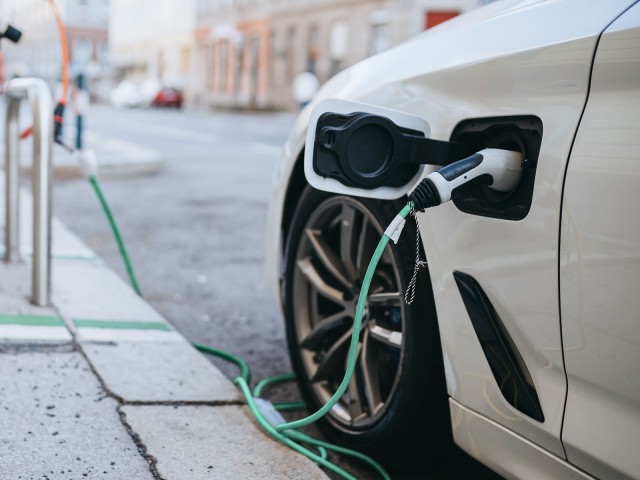
Put simply, there are two scenarios for the future: a 100 % fully electric vehicle fleet, or a mix of pure electric cars and hybrids based on electricity and e-fuels. Synthetic fuels also mean electricity consumption – but with several conversion steps in between. The electricity is not used directly, but is first converted into hydrogen and then into synthetic fuel. A great deal of energy is lost in the process. A BEV uses around 75 % of the electricity supplied. With e-fuels, only around 15% remains in the end. With the same amount of electricity, a BEV therefore travels around five times as far as a vehicle powered solely by e-fuel. A hybrid saves fuel as long as it drives electrically. But once the combustion engine kicks in, it needs fuel – after 2035, that means e-fuel, and thus indirectly electricity – and quite a lot of it. In a scenario in which 30 % of new registrations after 2035 are still hybrids running on e-fuels, the additional electricity demand in 2050, according to our calculations, could quickly exceed 200 TWh for passenger-car traffic in Germany alone. By way of comparison: today, Germany consumes around 500 TWh in total. If the old combustion-engine vehicles were also to run on e-fuels, the calculated electricity demand would exceed 500 TWh in 2035.
Hybride drives:
Plug-In: drive via a battery that can be charged from a socket or charging point
Range extender: vehicle drives electrically; a combustion engine generates electricity for the battery when needed
Classic hybrids: battery cannot be charged externally; only short distances electrically
Scarcity has its price
E-fuels solve one problem – and create a new one. Producing them requires hydrogen, ideally from renewable electricity. For Germany, this means that we will probably have to import e-fuels on a large scale. The price for consumers? Significantly above today’s fuel prices. In addition, industry, shipping and aviation also need e-fuels and hydrogen – except that there are hardly any better alternatives there so far. This is different for passenger cars: fully electric vehicles already represent a significantly more efficient technology today. Using e-fuels in cars is technically possible and has the advantage of building on existing infrastructure. In the long term, however, it makes only limited sense.

Hydrogen production
In 2026, the Karlsruhe Institute of Technology ( KIT ) and the Fraunhofer Institute ISE presented new methods for hydrogen production that no longer compete with the power supply for green electricity. This is still a vision for the future, but the examples show that technological progress can be part of the solution.
Openness to technology, yes – but not as a blank cheque
The vehicle fleet is a slow-moving mass: on average, a vehicle is in use for around 17 years. Some combustion-engine vehicles and hybrids from 2035 will therefore still be on the road in 2050. A solution is needed for these vehicles. Charging infrastructure would also have to be massively expanded if Europe were to rely solely on electricity from 2035 onwards.
Then there is the industrial-policy problem. A hard cut in 2035 would hit value chains, supplier structures and jobs. A middle way is conceivable: hybrids continue to be registered after 2035 – but only to a limited extent. Their share of new registrations declines year by year – a clear phase-out path by 2050. At the same time, they may only be operated with CO2-neutral fuels.
This would leave more time for industry to transform, and e-fuels would not become a permanent solution for passenger cars. Openness to technology would then have a clear framework. It would not be a blank cheque to perpetuate inefficient paths, but a bridge to the future. Hybrids could help cushion the structural break. As a mass-market solution beyond 2050, however, they would be the more expensive and more electricity-intensive route in the passenger-car segment.
Sabrina Kremer, Senior Sustainability Analyst
Download "focus on facts"
-
1.3 MB | 27.07.2026
This publication is addressed exclusively at recipients in the EU, Switzerland, Liechtenstein and the United Kingdom.
This report is not being distributed by LBBW to any person in the United States and LBBW does not intend to solicit any person in the United States.
LBBW is under the supervision of the European Central Bank (ECB), Sonnemannstraße 22, 60314 Frankfurt/Main (Germany) and the German Federal Financial Supervisory Authority (BaFin), Graurhein-dorfer Str. 108, 53117 Bonn (Germany) / Marie-Curie-Str. 24-28, 60439 Frankfurt/Main (Germany).
This publication is based on generally available sources which we are not able to verify but which we believe to be reliable. Nevertheless, we assume no liability for the accuracy and completeness of this publication. It conveys our non-binding opinion of the market and the products at the time of the editorial deadline, irrespective of any own holdings in these products. This publication does not replace individual advice. It serves only for informational purposes and should not be seen as an offer or request for a purchase or sale. For additional, more timely in-formation on concrete investment options and for indi-vidual investment advice, please contact your investment advisor.
We retain the right to change the opinions expressed herein at any time and without prior notice. More-over, we retain the right not to update this information or to stop such updates entirely without prior notice.
Past performance, simulations and forecasts shown or described in this publication do not constitute a reliable indicator of future performance.
The acceptance of provided research services by a securities services company can qualify as a benefit in supervisory law terms. In these cases LBBW assumes that the benefit is intended to improve the quality of the relevant service for the customer of the benefit recipient.
Additional Disclaimer for recipients in the United Kingdom:
Authorised and regulated by the European Central Bank (ECB), Sonnemannstraße 22, 60314 Frank-furt/Main (Germany) and the German Federal Financial Supervisory Authority (BaFin), Graurheindorfer Str. 108, 53117 Bonn (Germany) / Marie-Curie-Str. 24-28, 60439 Frankfurt/Main (Germany). Authorised by the Prudential Regulation Authority. Subject to regulation by the Financial Conduct Authority and limited regulation by the Prudential Regulation Authority. Details about the extent of our regulation by the Prudential Regulation Authority are available from us on request.
This publication is distributed by LBBW to professional clients and eligible counterparties only and not retail clients. For these purposes, a retail client means a person who is one (or more) of (i) a client as defined in point (7) of Article 2(1) of the UK version of Regulation (EU) 600/2014 which is part of UK law (UK MiFIR) by virtue of the European Union (Withdrawal) Act 2018 (EUWA) who is not a professional client (as defined in point (8) of Article 2(1) of UK MiFIR); or (ii) a customer within the meaning of the provisions of the Financial Services and Markets Act 2000 (as amended, the FSMA) and any rules or regulations made under the FSMA (which were relied on immediately before the 31 December 2020 (IP completion day)) to implement Directive (EU) 2016/97 on insurance distribution, where that customer would not qualify as a professional client, as defined in point (8) of Article 2(1) of UK MiFIR; or (iii) not a qualified investor as defined in the UK version of Regulation (EU) 2017/1129 on the prospectus to be published when securities are offered to the public or admitted to trading on a regulated market, which is part of UK law by virtue of the EUWA (the UK Prospectus Regulation).
This publication has been prepared by LBBW for information purposes only. It reflects LBBW’s views and it does not offer an objective or independent outlook on the matters discussed. The publication and the views expressed herein do not constitute a personal recommendation or investment advice and should not be relied on to make an investment decision. The appropriateness of a particular investment or strategy will depend on an investor’s individual. You should make your own independent evaluation of the relevance and adequacy of the information contained in this publication and make such other investigations as you deem necessary, including obtaining independent financial advice, before partici-pating in any transaction in respect of the financial instruments referred to this publication herein.
Under no circumstance is the information contained within such publication to be used or considered as an offer to sell or a solicitation of an offer to buy any particular investment or security. Neither LBBW nor any of its subsidiary undertakings or affiliates, directors, officers, employees, advisers or agents accepts any responsibility or liability whatsoever for/or makes any representation or warranty, express or implied, as to the truth, fullness, accuracy or completeness of the information in this publication (or whether any information has been omitted from the publication) or any other information relating to the, whether written, oral or in a visual or electronic form, and howsoever transmitted or made available or for any loss howsoever arising from any use of this publication or its contents or otherwise arising in connection therewith.
The information, statements and opinions contained in this publication do not constitute or form part of a public offer. LBBW assumes no responsibility for any fact, recommendation, opinion or advice con-tained in any such publication and expressly disclaims any responsibility for any decisions or for the suitability of any security or transaction based on it. Any decisions that a professional client or eligible counterparty may make to buy, sell or hold a security based on such publication will be entirely their own and not in any way deemed to be endorsed or influenced by or attributed to LBBW.
LBBW does not provide investment, tax or legal advice. Prior to entering into any proposed transaction on the basis of the information contained in this publication, recipients should determine, in consultation with their own investment, legal, tax, regulatory and accounting advisors, the economic risks and merits, as well as the legal, tax, regulatory and accounting characteristics and consequences, of the transac-tion.