February 11, 2026
LBBW shows exhibition "Bildstörung"
At the Lange Nacht der Museen 2026 in Stuttgart, curator Birgit Wiesenhütter is showing works that challenge our perception.
Night of Museums in Stuttgart | Saturday, 21 March BW-Bank at the Kleiner Schlossplatz
With works by, among others: Volker Hildebrandt, Viktoria Binschtok, Nina Canell, Julian Charrière/Julius von Bismarck, Thomas Putze, Martha Rosler, Jonas Roßmeißl.
In 2026, the LBBW Collection will once again take part in the Long Night of Museums in Stuttgart. On 21 March from 6 p.m., the exhibition "Bildstörung" by Birgit Wiesenhütter will be on display at the Kleiner Schlossplatz in the BW Bank headquarters alongside insights into the bank’s art collection.
The works in the exhibition show different types of image interference: Interruptions to reading, obstacles to our perception, irritating additions, comments on mass media combined with the question of truth in images ‒ a question that has become explosive, not least due to the technological developments of recent years.
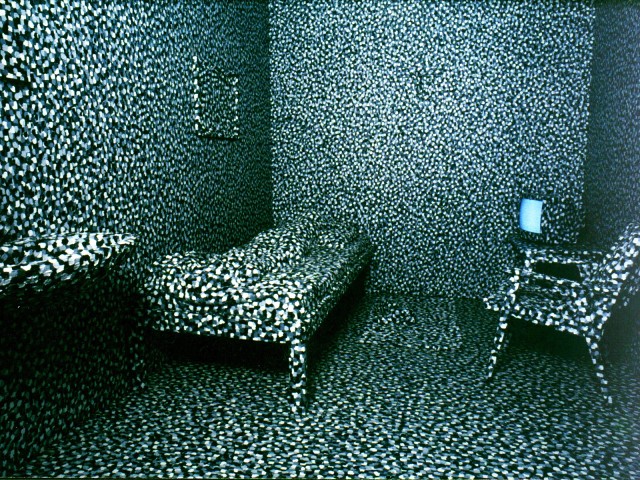
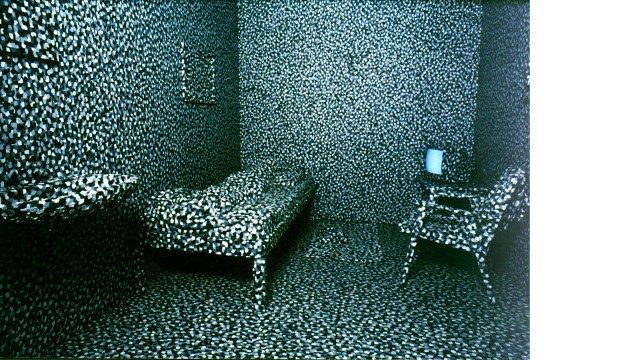
In Volker Hildebrandt's work „Bildstörung“, "image interference", as a phenomenon from analogue television, occupies a central place. The flickering and noise that came through the airwaves onto the screen at the end of the official broadcasting time was what the medium itself produced when no picture was being broadcast. For Volker Hildebrandt, who belongs to the first generation to grow up with the mass medium of television, these were THE television images at the time: the only images produced by the medium itself, the only "true" television images, "an image of television reality, which in turn pretends to be an image of reality", as the artist says. He covers canvases, newspapers and objects with black, white and grey dots of an image disruption, thereby commenting on the medium of television in the traditional genre of painting. In the work "Rosa Zimmer" (1997), “pink room”, he covers an entire room with the flickering and rustling of the dots. Contours and dimensions become unrecognisable and barely perceptible in the installation, everything becomes blurred, our perception is overwhelmed.
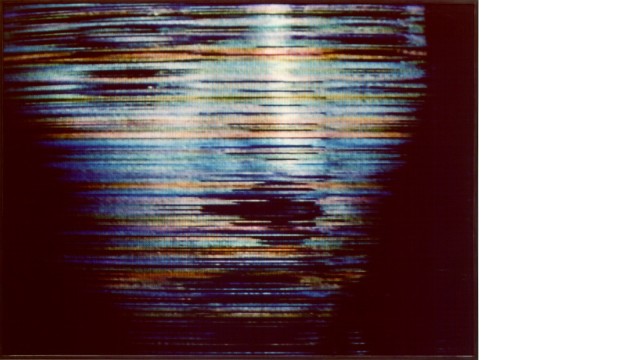
In another series, Hildebrandt dealt with the encrypted images of the pay-TV channel Premiere. The encoded images appear intentionally distorted without a decoder. The artist shows them as still images in the work "P 20" (1996), and says: "They are the only images in the entire television image complex that require imagination. (...) Moreover, they are real television images, i.e. they are formed from the basic structure of "image disturbance" and are also deliberately disturbed." So here we have an image disturbance in a double sense.
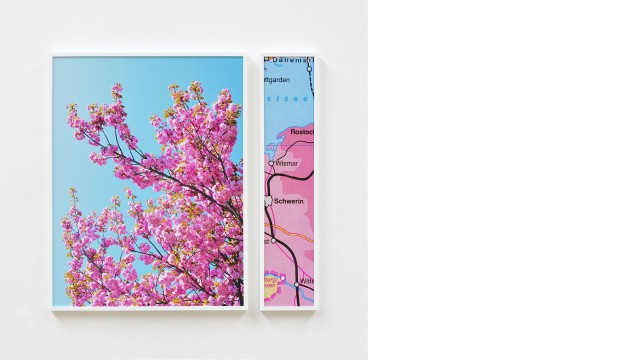
Viktoria Binschtok creates a different form of image interference in the "Clusters" series, in which the artist combines images found on the Internet with her own photographs. She feeds images from her own archive into an image-to-image search engine to see which formally similar images the algorithms associate. The results of this automated search then form the basis for another photograph of the motif, leaving room for alterations and digital editing. The combination and manipulation of the found image material leads to a new interpretation. Images from completely different contexts are combined: In "Cherry Blossom" (2020) a section of a pink blossoming Japanese cherry tree is combined with a section of a map of Germany - both images complement each other in colour and form, but have nothing to do with each other in terms of content. Which of them comes from the Internet and which from the artist's archive remains unanswered. Origin and authorship no longer play a role, the individual image loses its uniqueness and becomes part of a system. In "Cluster", the Internet appears less as a communication space and more as a data warehouse. The lack of hierarchy of the Internet, which places images from very different contexts side by side on an equal footing without asking about meaning, origin and content, becomes obvious.
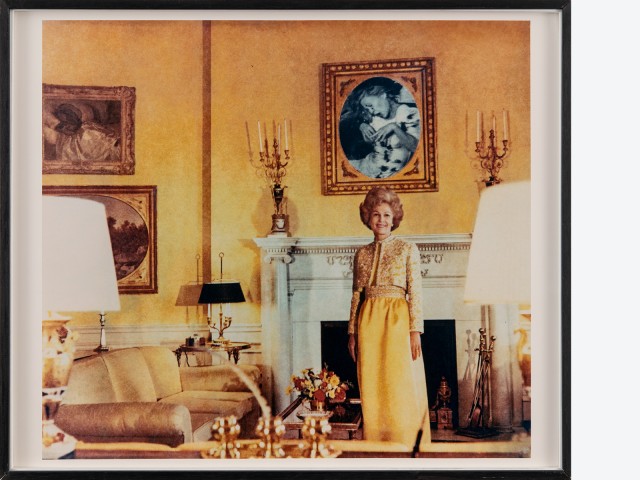
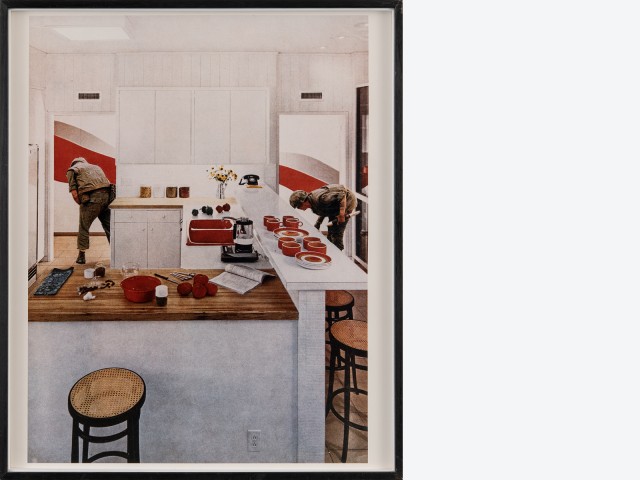
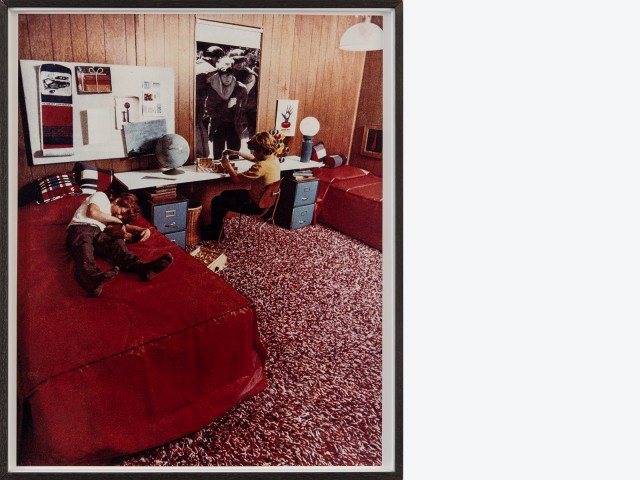
The series "Home Beautiful: Bringing the War Home" by Martha Rosler was created between 1967 and 1972 during the Vietnam War, which became known as the "living room war" as it was the first war that could be watched on television in living rooms from a safe distance. Initially, the 20 photomontages were intended as an agitational act by the artist and not as art and were mainly distributed on leaflets. The disruption of the image here is quite obviously due to the intervention that Rosler carries out with images from interior magazines (especially the eponymous "Home Beautiful"): Brutal images of war, which often came from LIFE magazine, find their way into the cosy home: as a view from the window, as in "Boy's Room", or in the form of soldiers whose presence in a modern American kitchen seems surreal, as in "Red Stripe Kitchen". Rosler thus connects two completely different worlds and makes it clear that both realities belong together.

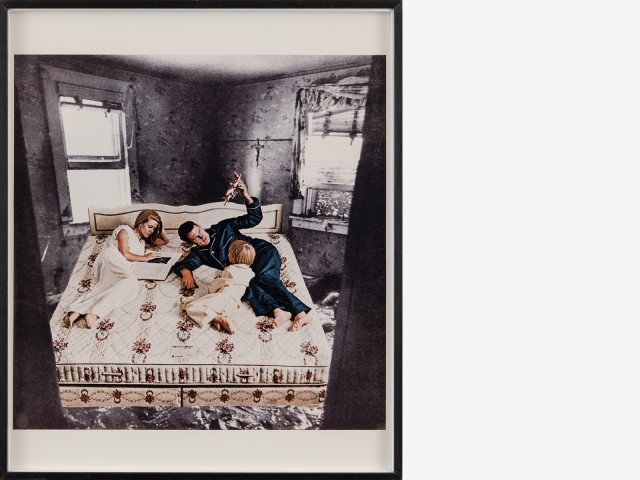
Disturbances in images make us pause in our usual reception of images and raise questions. Artists have always irritated our perception with their works, questioning what we see. Our perception of the world today is primarily characterised by images from technical media. "What is real and what is not? What influence do they have on us? Image interference makes some of this tangible. Some of us might like to see a real image interference from analogue television, an interruption to the stream of data and the flood of images, a pause that makes us stand still and reflect," says curator Birgit Wiesenhütter.
Buy your tickets for the Lange Nacht 2026 in Stuttgart now and visit the "Bildstörung" at Kleiner Schlossplatz!
Guided tours from 18:10-1:00, every 10 minutes, duration: approx. 30 minutes.
Performance by artist Thomas Putze and cellist Winfried Stürzl at 7, 8 and 9 pm
Throwback: Lange Nacht 2025 at the BW Bank, Kleiner Schlossplatz:
Do you have any questions? Please contact us!