November 06, 2026
Postcard from Paris
France’s government between Scylla and Charybdis.


To the point!

"Business sentiment is subdued. Consumption and private in-vestment are correspondingly weak."
This week, work took me back to France for a speaking engagement, my first visit in a while. I also met up with my daughter, who is spending a semester in Paris on the Erasmus studentexchange program. Not necessarily at university, though: protesters have been blocking access for weeks. Instead, she is spending her time studying the city – not by choice, but certainly enjoying herself and learning plenty.
France is in a real bind. Crowds are taking to the streets to demand more spending on education and a lower cost of living – at times resorting to violence, arson and looting. On Saturday, I witnessed clashes between protesters and security forces at the Place de la Bastille.
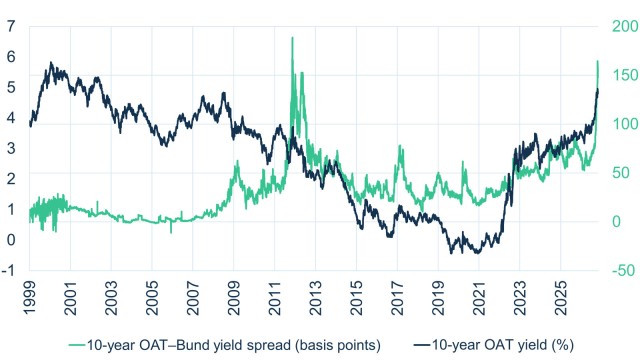
Meanwhile, French government bonds are under pressure. With yields approaching 5%, public finances already out of control are coming under further strain. The yield spread over German government bonds has reached 160 basis points (see fig. 1). It was last this wide during the euro crisis. Back then, Germany was still seen as the guardian of fiscal prudence. Those days are gone, too. France’s government is now struggling to secure a majority for its 2027 budget. The draft envisages a deficit of 5%. That is distinctly unambitious.
Fig. 1: French government Bonds
Interest Spread over Bunds
Présidente Le Pen at the gates
Complicating matters further, a presidential election is due in April. Marine Le Pen of the right-wing National Rally (RN) is considered a strong contender and could well enter the Élysée Palace on her fourth attempt. The good news is that the RN’s platform is less radical than it once was, when the party toyed with such reckless ideas as leaving the euro.
Le Pen would certainly not be investors’ preferred candidate. There are worse alternatives: Jean-Luc Mélenchon, leader of the populist left-wing party La France Insoumise (LFI), advocates canceling outright the government debt held by the central bank. That would probably have adverse consequences elsewhere in the euro area, too, since it would call the rule of law into question. Fortunately, the likelihood of this happening is very low.
The approaching election leaves little political room for maneuver. Emmanuel Macron’s centrist government lacks a majority; so would the RN or the far left. The rival camps block one another, understandably unnerving markets. In 2018, fiscal concessions helped quell protests by the so-called yellow vests, or gilets jaunes. Today, that escape route is closed. Capital markets would punish any such concessions severely.
The government led by Prime Minister Sébastien Lecornu must navigate this fiscal strait much as Ulysses sailed between the sea monsters Scylla and Charybdis in Greek mythology. Whether it can do so remains an open question.
The sick man of Europe
Business sentiment is subdued. Consumption and private investment are correspondingly weak. Little wonder that real GDP has stagnated for a year (see fig. 2). Since the final quarter of 2025, France has been the worst performer among the euro area’s four largest economies. That makes the necessary structural fiscal adjustment still more challenging.
Fig. 2: Quarterly GDP growth rates
Yet this is not a second euro crisis. Nor should it become one. With government spending accounting for 57% of GDP, there ought to be ample scope for savings. There are also signs that investors would return to French government bonds at yields above 5%.
The European Central Bank is extremely unlikely to deploy its Transmission Protection Instrument (TPI) for France. The TPI would allow the ECB to target its purchases at a particular country’s government bonds. But the instrument is intended for governments facing speculative attacks through no fault of their own. France could hardly claim to meet those conditions. And the ECB can only buy time anyway. Paris must put its own house in order.
The prospects for structural solutions look bleak before the election. Le Pen at least talks about fiscal consolidation. But spelling out how she would repair the public finances is naturally difficult for a populist politician. Specifically, she has proposed reducing France’s contributions to the EU. Since those are governed by treaty, little is likely to come of that. Investors will probably have to tighten the screws further before the government can bring itself to take measures that put the public finances on a sustainable footing.
Dr. Moritz Kraemer, Chief Economist / Head of Research at LBBW
Download To the point!
-
1.3 MB | November 06, 2026
This publication is addressed exclusively at recipients in the EU, Switzerland, Liechtenstein and the United Kingdom.
This report is not being distributed by LBBW to any person in the United States and LBBW does not intend to solicit any person in the United States.
LBBW is under the supervision of the European Central Bank (ECB), Sonnemannstraße 22, 60314 Frankfurt/Main (Germany) and the German Federal Financial Supervisory Authority (BaFin), Graurhein-dorfer Str. 108, 53117 Bonn (Germany) / Marie-Curie-Str. 24-28, 60439 Frankfurt/Main (Germany).
This publication is based on generally available sources which we are not able to verify but which we believe to be reliable. Nevertheless, we assume no liability for the accuracy and completeness of this publication. It conveys our non-binding opinion of the market and the products at the time of the editorial deadline, irrespective of any own holdings in these products. This publication does not replace individual advice. It serves only for informational purposes and should not be seen as an offer or request for a purchase or sale. For additional, more timely in-formation on concrete investment options and for indi-vidual investment advice, please contact your investment advisor.
We retain the right to change the opinions expressed herein at any time and without prior notice. More-over, we retain the right not to update this information or to stop such updates entirely without prior notice.
Past performance, simulations and forecasts shown or described in this publication do not constitute a reliable indicator of future performance.
The acceptance of provided research services by a securities services company can qualify as a benefit in supervisory law terms. In these cases LBBW assumes that the benefit is intended to improve the quality of the relevant service for the customer of the benefit recipient.
Additional Disclaimer for recipients in the United Kingdom:
Authorised and regulated by the European Central Bank (ECB), Sonnemannstraße 22, 60314 Frank-furt/Main (Germany) and the German Federal Financial Supervisory Authority (BaFin), Graurheindorfer Str. 108, 53117 Bonn (Germany) / Marie-Curie-Str. 24-28, 60439 Frankfurt/Main (Germany). Authorised by the Prudential Regulation Authority. Subject to regulation by the Financial Conduct Authority and limited regulation by the Prudential Regulation Authority. Details about the extent of our regulation by the Prudential Regulation Authority are available from us on request.
This publication is distributed by LBBW to professional clients and eligible counterparties only and not retail clients. For these purposes, a retail client means a person who is one (or more) of (i) a client as defined in point (7) of Article 2(1) of the UK version of Regulation (EU) 600/2014 which is part of UK law (UK MiFIR) by virtue of the European Union (Withdrawal) Act 2018 (EUWA) who is not a professional client (as defined in point (8) of Article 2(1) of UK MiFIR); or (ii) a customer within the meaning of the provisions of the Financial Services and Markets Act 2000 (as amended, the FSMA) and any rules or regulations made under the FSMA (which were relied on immediately before the 31 December 2020 (IP completion day)) to implement Directive (EU) 2016/97 on insurance distribution, where that customer would not qualify as a professional client, as defined in point (8) of Article 2(1) of UK MiFIR; or (iii) not a qualified investor as defined in the UK version of Regulation (EU) 2017/1129 on the prospectus to be published when securities are offered to the public or admitted to trading on a regulated market, which is part of UK law by virtue of the EUWA (the UK Prospectus Regulation).
This publication has been prepared by LBBW for information purposes only. It reflects LBBW’s views and it does not offer an objective or independent outlook on the matters discussed. The publication and the views expressed herein do not constitute a personal recommendation or investment advice and should not be relied on to make an investment decision. The appropriateness of a particular investment or strategy will depend on an investor’s individual. You should make your own independent evaluation of the relevance and adequacy of the information contained in this publication and make such other investigations as you deem necessary, including obtaining independent financial advice, before partici-pating in any transaction in respect of the financial instruments referred to this publication herein.
Under no circumstance is the information contained within such publication to be used or considered as an offer to sell or a solicitation of an offer to buy any particular investment or security. Neither LBBW nor any of its subsidiary undertakings or affiliates, directors, officers, employees, advisers or agents accepts any responsibility or liability whatsoever for/or makes any representation or warranty, express or implied, as to the truth, fullness, accuracy or completeness of the information in this publication (or whether any information has been omitted from the publication) or any other information relating to the, whether written, oral or in a visual or electronic form, and howsoever transmitted or made available or for any loss howsoever arising from any use of this publication or its contents or otherwise arising in connection therewith.
The information, statements and opinions contained in this publication do not constitute or form part of a public offer. LBBW assumes no responsibility for any fact, recommendation, opinion or advice con-tained in any such publication and expressly disclaims any responsibility for any decisions or for the suitability of any security or transaction based on it. Any decisions that a professional client or eligible counterparty may make to buy, sell or hold a security based on such publication will be entirely their own and not in any way deemed to be endorsed or influenced by or attributed to LBBW.
LBBW does not provide investment, tax or legal advice. Prior to entering into any proposed transaction on the basis of the information contained in this publication, recipients should determine, in consultation with their own investment, legal, tax, regulatory and accounting advisors, the economic risks and merits, as well as the legal, tax, regulatory and accounting characteristics and consequences, of the transac-tion.