
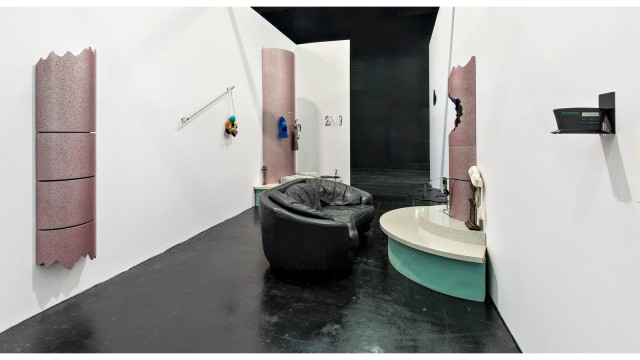
In her installations, Henrike Naumann used furniture and everyday objects as documentary material: like pieces of evidence, they refer to social upheavals, political ideologies and their aesthetic manifestations. Through interior design, design codes and the deliberate arrangement of furnishing elements, she negotiated questions of memory culture, power relations and the visibility of historical processes in everyday life.
In the following conversation from 2023 with Sarah Haberkorn, Head of the LBBW Collection, Henrike Naumann spoke about her working methods, her work "Fun 2000" (2018) from the LBBW Collection and how Expo 2000 and the Treuhandanstalt are linked in this installation.
Sarah Haberkorn, LBBW Collection: You mainly work with furniture in order to convey historical and social themes. Why did you choose this material?
Henrike Naumann: To me, furniture is a kind of evidence. I ask myself: Does an aesthetic of radicalization exist? Or: What do neoliberal side tables look like? I then go on a search with thoughts like these. Furniture is also very accessible. Everyone knows and uses it. On the one hand, you can use furniture to talk about people without having to show them yourself. On the other hand, the viewers can enter the installation and become performers. The furniture therefore offers the opportunity to talk about the past. At the same time, the present is always present. This approach to history interests me, because to me it is not about an escape into nostalgia, but about the question what relevance the past has for our present or what happens if it is not dealt with.
Haberkorn: With the work "Fun 2000" you refer to the world exhibition in Hanover. How did you become interested in this topic?
Naumann: I became aware of it because the former president of the Treuhandanstalt, Birgit Breuel, was the general commissioner of Expo 2000. The Treuhand is a complex topic in terms of East-West German relations. I have been researching it for some time, but I realised that in my perception there were no multifaceted visual references and no clear aesthetics to the Treuhand. Expo 2000, on the other hand, was a huge image production machine, which in retrospect raises the question of what content it intended to convey. So I used the visual overproduction of Expo 2000 to talk about the mass privatization of the Treuhand.
Haberkorn: How did you implement that?
Naumann: One architectural proposal for the German pavilion at the time was to push East and West Germany together with elements. I thought that was so ambitious and funny. In my installation, I did the exact opposite and pulled everything apart. I took the furniture from an old shoe shop. There is also a video work in which I used interviews with Birgit Breuel and GDR (German Democratic Republic) workers for the soundtrack. The latter had just learned that their companies were being closed by the Treuhand. Visualisations from an old Expo CD-ROM can be seen on the image layer. Looking at the data carrier from that time was like media archaeology. No longer compatible with today's computer systems, I was shown hundreds of incoherent image files – from pyramids to the Oktoberfest. It was like trying to decipher hieroglyphics. The work also contains other relics from the Expo context, such as the mascot Twipsy. According to an information sheet, it stands for the Internet and digitalisation. It has a huge hand, as Twipsy closes many deals. I find that very revealing and honest. After all, Expo 2000 was primarily about Germany as a business location. I'm interested in taking things that seem strange at first glance seriously and using them to talk about socio-political processes.
Haberkorn: How do you see "Fun 2000" in the context of a corporate collection?
Naumann: I think the installation is great in this context. Because "Fun 2000" is about companies in relation to society and how Expo 2000 presented social concepts with a neoliberal perspective on the world.
Biography
Henrike Naumann (1984 – 2026): Born in Zwickau, lived and worked in Berlin until her death in 2026. She studied stage and costume design at the Dresden University of Fine Arts from 2006 – 2008 and scenography at the HFF Konrad Wolf Potsdam-Babelsberg from 2008 – 2012. In 2026, Henrike Naumann designed the German Pavilion at the Venice Biennale together with Sung Tieu.
Solo exhibitions included the Berlin Wall Memorial in the Bundestag, Sculpture Center (NY, USA). Kunsthaus Dahlem, Belvedere 21 (Vienna, AT) and the Museum Abteiberg. In addition to the LBBW Collection, her works are represented in the following collections, among others: Harvard Art Museum, Bundekunstsammlung, Belvedere 21, Kunstsammlung Nordrhein-Westfalen, Kunstpalast Düsseldorf and Museum Abteiberg Mönchengladbach.